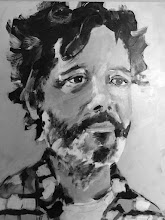
Fifty years ago, while an Oxbridge student in 1959, he founded New Departures, a magazine dedicated to new poetry. Kerouac's On The Road had just come out, CND marches were starting, Trad Jazz was the Alt. Rock of its day. Michael was the first man to publish extracts of William Burroughs.
Thursday, 17 September 2009
Michael Horovitz OBE
Fifty years ago, while an Oxbridge student in 1959, he founded New Departures, a magazine dedicated to new poetry. Kerouac's On The Road had just come out, CND marches were starting, Trad Jazz was the Alt. Rock of its day. Michael was the first man to publish extracts of William Burroughs.
Michael Horovitz OBE
Fifty years ago, while an Oxbridge student, he founded New Departures, a magazine dedicated to new poetry. Kerouac's On The Road had just come out, CND marches were starting, Trad Jazz was the Alt. Rock of its day. Michael was the first man to publish extracts of William Burroughs.
As the Sixties got going he was one of the poets at the famous Albert Hall poetry event in 1965. He's captured for ever in Peter Whitehead's film of the event, Wholly Communion.
Wednesday, 1 July 2009
What a Long, Strange Trip It’s Been…
Ralph Metzner, October Gallery, London June 16th 2009
The October Gallery in London has been doing a series of talks on the nature of consciousness. Step forward, for one night only, Ralph Metzner. Who he? Well, now children…
Back in the 1950s all sorts of folk, including the CIA, were looking at drugs. LSD 25 was one of those drugs. Metzner, a graduate student at Harvard, helped Timothy Leary and Richard “Baba Ram Dass” Alpert in their studies into this new field. This is before it was illegal and a counter-culture developed. Why, it was even a fashionable thing in Hollywood and people like Cary Grant swore by it.
Leary urged the world to “tune in, turn on, drop out”. Metzner helped, tripping with the likes of Kesey, Cassady and Kerouac. But he’s no burnt out acid casualty. Far from it. His interest in the human brain and consciousness has been his life’s work and, indeed, he’s a respected academic.
Recently he’s published his own account of those heady daze, to give his side of the Tale of The Sixties. And so a small audience gathers at the October to see and hear a living link to those times. A primary source.
The evening was a gentle affair. We were shown a trailer for a documentary film about Leary and Alpert, based on home footage shot before Leary’s death. It looked lo-fi but fun. Then Metzner, a twinkly 70 year old, read a few passages from his book. Nothing heavy, just a few glimpses into what it was like to explore the inner mind back then.
The Q&A session after was too short but showed a healthy sense of humour and lack of concern for authority. They took LSD themselves to have a subjective understanding of what people went through otherwise, “it’s kinda boring taking notes for 6 hours of someone going “Wow!””. Harvard didn’t like their approach. Others, like Huxley, believed LSD was only for the cultural elite. Metzner agreed more with Leary’s egalitarian American classlessness: everyone should have the chance.
The talk ended with a quick slide show of the L’Omo tribe of Africa. Incredible painted faces and bodies, that seemed to fuse the human with plant. It captured the trippiness of a drug experience and the power of the mind to project and actualise thoughts, feelings and environment. Phew.
Ralph Metzner. A footnote in the alternative history of the Universe.
Hockney
I like David Hockney. He's no nonsense, down-to-earth. The BBC had a great doc about him last night and for 48 hours they've made available some "phone art" to download.Friday, 26 June 2009
Wacko

I was always too much of a punky rocker to "get" Michael Jackson. Now, like Abba, I can dance at a party to a few tunes but it's no more than nursery songs. Inoffensive, sure. But I don't get this idea of him as King of Pop (a title he insisted upon). You want a Pop star? Marc Bolan, back in the day, worked for me fine. Jacko's videos were BIG and that helped spread the fame but, really, how many of the 70 million people who bought "Thriller" actually listen to it? It's entertaining enough but without the video would it have been so huge? So, cheesy pop in itself isn't a crime. Just doesn't rock my boat. And then there's all the kiddy fiddling, surgery, Scientology etc. Yeah, yeah, he had a shit childhood, but all that squeaky, high-voice whining on shows like Oprah hid the fact he was a 50 year old man. He knew what he was doing. I'm not saying he's Gary Glitter but there was something not quite right there...
Friday, 19 June 2009
Sixties Photo Exhibition
John “Hoppy” Hopkins, Idea Generation Gallery, London, June 2009.
Hoppy’s the biggest hippy you’ve never heard of. His is not the Daily Mail version of the Sixties with minis, Twiggy and World Cup ’66. He pretty much started the counter-culture in Sixties London. Now, he’d be called a social entrepreneur. Then, he was a face about town. Making things happen. He knew everybody. He set up Europe’s first underground newspaper (International Times) and psychedelic club (UFO). He gave out copies of a groovy address book: sheets of Gestetnered paper, stapled together with names of cool folk for like-minded souls, like a lo-fi Internet. He set up the 14 Hour Technicolor Dream at Ally Pally, the UK’s own version of the Acid Tests. He was busted and sent to jail on the day Sgt Pepper was released. The judge called him, “a menace to Society”.
He also took photos that paid his way in the early days. Some are well known (Beatles, Stones, usual suspects) but others are street scenes, a drug deal, prostitutes, tattooist, bikers, CND demos, Jazzmen. The subculture, before it was called that.
His eye was great. Hoppy says it was all intuition and instinct. He’s a Cambridge physics and maths graduate so the tech-y bit was easy. The basics, like composition, are there too. It’s his ease with the snapshot moment that impresses. Shapes and faces look as fresh as when he hit the shutter. But also, timeless. Grey, dirty, bombed out, early Sixties London looks almost Victorian and strangely “now”. Perhaps it’s because we don’t normally see pictures like that from the Sixties. It wasn’t all a swirly-coloured Love-in.
Familiar places and faces you think you know appear different. They startle. Compared to the routinely rolled out stock images of the period, their unfamiliarity makes us see things anew. The Jazz pictures are glorious. Close-ups of Monk’s hands. Ornette Coleman blowing blissfully. (Coleman stayed with Hoppy on his first UK tour in 1965 and by coincidence is in town for Meltdown). The Stones at Ally Pally in 1964 look gorgeous: Brian Jones with his back to the crowd and light breaking through the huge circular window. Ringo staring blankly; John smoking a fag. Marriane smiling. Martin Luther King, close-up, thinking.
It’s all here. The Idea Generation have done a great job hanging and getting the word out. This collection and Hoppy’s archive are an untapped source of wonder. His version of events goes much deeper than received wisdom.
The Sixties will exert a much bigger pull as decades go by. Everything “normal’ today kicked off then. And, sadly, it’ll be a while before the sheer joy and innocence and innovation of that era roams the planet again, if ever. Until then, work like Hoppy’s gives us, and future generations, a beautiful glimpse into that Time and Place. Far out.
Monday, 27 April 2009
Mick Jones Rock n Roll Library
Mick Jones’ Rock n Roll Library,
Chelsea Art Space. April 2009.
Mick Jones was in The Clash. For boys of a certain age, ahem, this bestows on him Godlike status. I loved The Clash and they are still the best band I’ve ever seen live. But that’s not important right now.
Mick as a form of protest against the British Music Experience at the O2– the Starbucking of British Rock – has put on display a tenth of his Acton lock-up. Thus we get old Clash flight cases, books, real-time Punk fanzines, videos, scribbled notes, shirts, toys, guitars, movie posters, mix tapes and ephemera from a Lifetime.
Mr Jones says all the artefacts go some way to explain where he came from and who he is. A lot of it will be familiar to anybody born before 1980 and had even a smidge of interest beyond the mainstream. A time before all our groovy, modern ways of accessing culture, when John Peel and the NME were pretty much the only ways of learning about the world, beyond whatever small part of the UK you lived in.
Is it Art though? Does the fact it’s on display in a “proper” Art space confer Art-ness. And if it wasn’t Mick’s stuff would it mean anything? OK, I’m Fan Boy but I think it transcends its Clash-ness. As an exercise in cultural rippling, blending nostalgia with the here-and-now, it’s like a giant scrapbook or Pop Art installation. Images that were transient, temporary, fleeting now resonate against eachother. Calling up ghosts at once familiar but intangible. Memories bubbling up from the cortex.
So, yeah, it was kinda Art-y. It had that Thing-ness about it. You know, form and content, the thing itself and then what the thing represents, or could represent to whomever, depending. All that Art critic malarkey.
Mick wants to create a proper library where people could look at stuff or just hold it for a while, use it for reference or just shits and giggles. Coz in 100 years most stuff like this will be lost or in land fill. The “everyday” in this collection will one day tell us more about yesterday and today. Bit like Art.